UPCOMING EVENTS
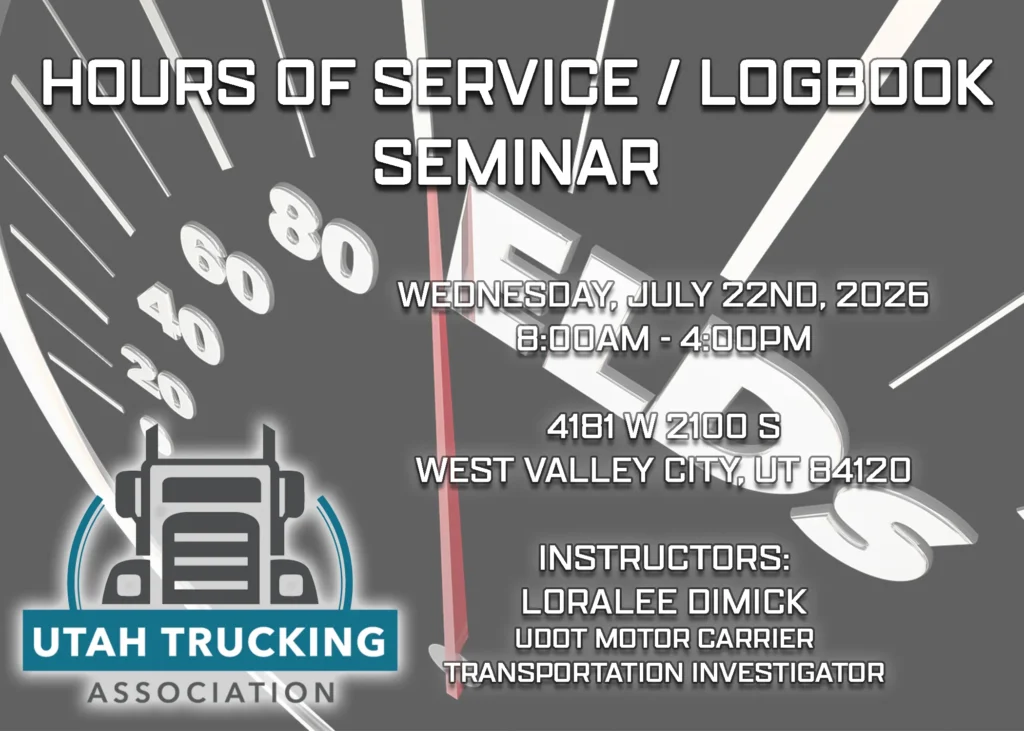
- July 22nd, 2026 – HOS/Logbook Seminar
- July 31st, 2026 – Southern Regional Luncheon
- August 6th – 7th, 2026 – 2026 Rocky Mountain Regional Safety Rendezvous
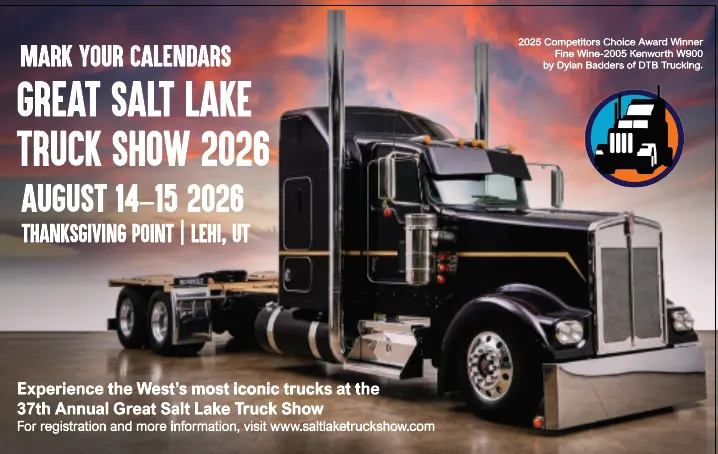
- August 14th – 15th, 2026 – Great Salt Lake Truck Show
- August 22nd, 2026 – Briderland Technical College Equipment Show
- August 28th – 29th, 2026 – The Basin’s Black Gold Truck Show
- September 1st, 2nd, 3rd, 2026 – Fishing the Green Experience
- September 29th, 2026 – Utah Trucking Association 2026 TruckPAC Golf Tournament
Announcements
Events:
2026 Rocky Mountain Regional Safety Rendezvous
August 6th – 7th, 2026 Coeur d’Alene Idaho

Completed forms should be submitted by email to: office@idtrucking.org



Resources:



Truckin Hot News:
Great Article Highlighting UTA Member Deseret Transportation
Petty: Church of Jesus Christ commemorates America 250
Deseret Transportation’s private fleet supports a nationwide food distribution effort using dedicated drivers, tractors, and trailers.
Strategic Tips for Posting Truck Driver Jobs: Where to Find Qualified Drivers
Discover the best platforms, job boards, and social media strategies to attract qualified CDL drivers faster.
Washington – Today, the American Trucking Associations welcomed four major U.S. Department of Transportation grants that will add new truck parking spaces along key freight corridors ranging from the western to the eastern United States. The $61.7 million investment announced by USDOT Secretary Sean Duffy will make it easier for truck drivers to locate safe parking.
“The chronic lack of truck parking poses a public safety risk, raises costs for consumers, and makes professional drivers’ tough jobs even harder. We appreciate Secretary Duffy’s commitment to addressing this longstanding problem and commend Illinois, Kentucky, Mississippi, and Wyoming for prioritizing truck parking projects in their transportation plans,” said ATA President & CEO Chris Spear. “When drivers finish their shift, they deserve to know that they will be able to find a safe place to sleep that night. Congress can help build on this investment by approving the $200 million for truck parking included in this year’s appropriations bill.”
The funding was awarded through USDOT’s Better Utilizing Investments to Leverage Development (BUILD) grant program, which provides grants for surface transportation infrastructure projects with significant local or regional impact. The grants were awarded as follows:
- The State of Illinois received $13.2 million to add 45 rest area spaces.
- The Commonwealth of Kentucky received $25 million to add truck parking spaces at seven rest areas and add real-time parking information systems.
- The State of Mississippi received $22.1 million to add 54 spaces to a rest area plus real-time parking information systems.
- The State of Wyoming received $1.4 million to improve winter parking for trucks.
According to a USDOT study, 98% of truck drivers regularly experience problems locating safe parking. An analysis by the American Transportation Research Institute found that the average driver sacrifices 56 minutes of drive time per day. This results in $6,813 in lost wages for truck drivers each year.
ATA has endorsed the Truck Parking Safety Improvement Act, introduced by Representatives Mike Bost (R-IL) and Angie Craig (D-MN), which would authorize $755 million in competitive grant funding to expand commercial truck parking capacity across the United States. Similarly, the BUILD America 250 Act, legislation proposed to reauthorize the nation’s surface transportation programs, would authorize $750 million over the next five years for the construction of truck parking.
Additionally, following ATA’s sustained advocacy, Congress approved $200 million for truck parking as part of the fiscal year 2026 appropriations package. Under the leadership of Transportation Appropriations Subcommittee Chairman Steve Womack (R-AR), Congress is working to approve an additional $200 million for truck parking in the upcoming fiscal year funding bill.
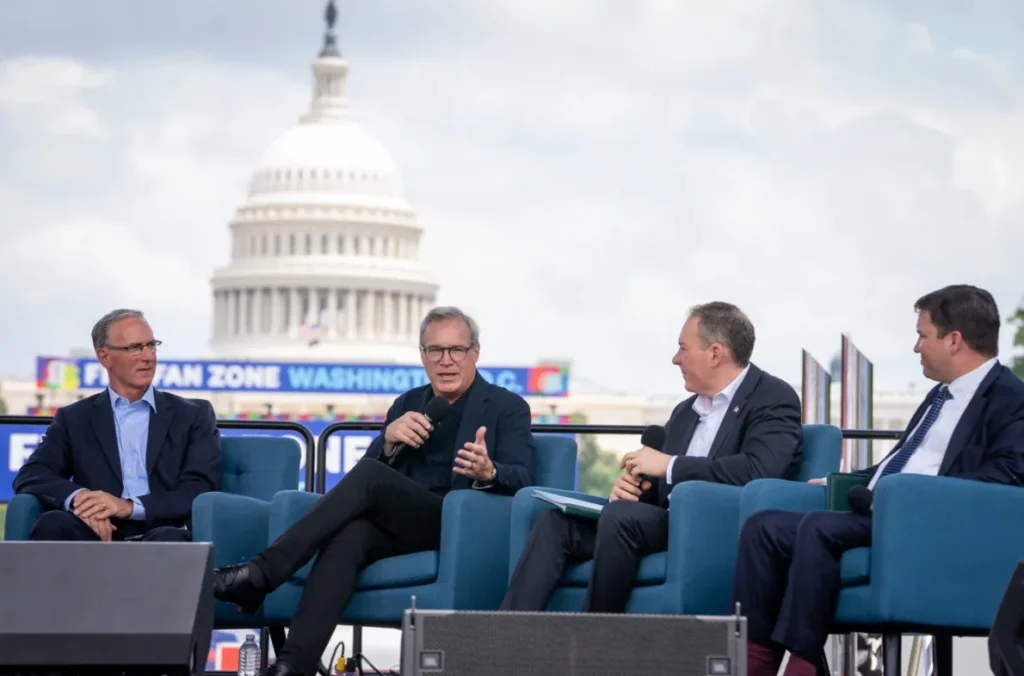
From left to right: PACCAR CEO Preston Feight, ATA President & CEO Chris Spear, EPA Administrator Lee Zeldin, and EPA Assistant Administrator for the Office of Air and Radiation Aaron Szabo on Freedom Stage at the Great American State Fair on the National Mall
Washington – Today, American Trucking Associations President & CEO Chris Spear joined Environmental Protection Agency Administrator Lee Zeldin for an event on the National Mall to celebrate the rollback of onerous, unachievable heavy-duty NOx standards implemented by the previous administration. EPA estimates that its proposed changes could reduce the cost of new trucks by as much as $6,000 and save American truckers $12 billion in overall costs.
EPA’s existing NOx rule threatened to cause major operational disruptions and significantly increase equipment costs for the trucking industry. ATA has strongly advocated for a reevaluation of the rule and sent a letter to EPAearlier this year requesting modifications. The agency’s proposed revisions incorporate many of ATA’s recommendations.
Following the announcement, Spear issued this statement:
“Since 1970, trucking has reduced heavy-duty emissions by 99%. That is real progress, and no one should pretend otherwise. But EPA’s 2022 rule demanded another 80% reduction in NOx emissions in just five years, forcing our industry to confront costly, complex technologies that have not been fully proven in real-world conditions.
“ATA has been clear from day one: new environmental standards must be achievable, affordable, and reliable. If a truck cannot perform safely and efficiently on America’s highways, then the freight does not move, shelves do not get stocked, and our economy pays the price.
“Administrator Zeldin and the Trump Administration heard us loud and clear. We appreciate EPA taking our concerns seriously and acting to provide commonsense flexibility for the manufacturers, fleets, and 8.4 million hardworking men and women who keep this country moving.
“ATA is now reviewing the full details of the proposal released today and looks forward to submitting official comments.”
On stage at the America 250 Great American State Fair on the National Mall, Spear, Zeldin, and OEM CEOs discussed the shortcomings of EPA’s existing NOx standards, which were finalized in December 2022. Beginning with model year 2027, EPA would have required a premature rollout of commercial motor vehicles with unproven engine technologies. In addition, the rushed implementation timeline encouraged a pre-buy that would have further driven up costs for equipment.
Zeldin and the trucking leaders also extolled the following benefits of the proposed rule:
- Warranty: Maintains the current 5-year / 100,000-mile warranty to reduce the cost of new trucks.
- Useful Life: Delays the scheduled increase to regulatory useful-life by three years so that the 11-year / 650,000-mile warranty for heavy-duty trucks will take effect in 2030.
- Production Volume Allowance: Allows up to five percent of a manufacturer’s U.S.-directed production to meet pre-2027 requirements in 2027-2029 without requiring the use of NOx credits as is currently required.
- Nonconformance Penalties: Allows manufacturers to sell medium-heavy and heavy-heavy duty vehicles that do not meet the .035 mg/hp-hr NOx standard provided they pay a fee based on the level of non-compliance.
- Credit Flexibilities: Seeks comments on specific provisions that would increase the availability and flexibility of NOx credits for manufacturers. These changes include potentially increasing the NOx FEL cap, allowing the use of NOx credits across engine service classes and allowing the use of NOx emission credits generated prior to model year 2022.
- Diesel Exhaust Fluid / SCR Derate: Eliminates the requirement for speed and power inducements and replaces them with visible and/or audible dashboard notifications for new trucks. EPA is also considering guidance to allow manufacturers to further adjust inducement schedules by software updates for the existing fleet of in-use highway and nonroad engines and equipment.
ATA will continue working with EPA throughout the rulemaking process and intends to submit formal comments supporting the proposal prior to the August 29 deadline. A public hearing is scheduled for July 29.
Washington, D.C. – The American Transportation Research Institute (ATRI) today released the 2026 Analysis of the Operational Costs of Trucking, its flagship benchmarking report.
The industry-average cost to operate a truck in 2025 was $2.336 per mile, 3.4 percent higher than the previous year and the highest per-mile cost in the report’s history. Excluding fuel, costs rose by 4.2 percent to $1.854 per mile.
Costs were up in all major line-items in 2025, with the largest percentage gains in tolls (13.2%), repair and maintenance (8.6%), driver benefits (6.6%), and tires (6.4%). Only two line-items rose at sub-inflationary rates: fuel and, for the second year in a row, driver pay. Truck and trailer procurement costs varied by fleet size amid high prices and low freight volumes. Small fleets spent less on trucks and trailers in 2025 than in 2024, while truckload fleets with more than 1,000 trucks spent 16.1 percent more. First-quarter 2026 data show a continuation of most 2025 cost trends.
Faced with rising costs and stagnant rates, carriers executed their largest reduction in freight capacity since the start of the freight recession in 2022 – reducing truck counts by 2.4 percent and leaving another 10 percent of trucks unseated on average. Other key metrics show the impact of this prolonged downturn on operations. Average truck age and annual mileage increased, deadhead mileage remained elevated, and non-driver staffing levels were cut by 7.8 percent.
Despite these austerity efforts, carrier profitability remained poor. Operating margins in the truckload and refrigerated sectors improved slightly but were still below 1.0 percent, while tank carriers averaged 4.0 percent. Only LTLs and fleets with more than 1,000 trucks had healthy – but flat year-over-year – margins in 2025. Flatbed carriers, however, had an average operating loss of -0.5 percent.
“Freight rates are finally turning a corner in 2026, but the acceleration of industry-wide costs means that fleets must continue with aggressive cost discipline,” said PGT Trucking, Inc. Chief Operating Officer Chad Marsilio. “ATRI’s Operational Costs and the customized benchmarking reports provide vital intelligence for balancing cost management and performance as we prepare our fleet for the much-needed trucking recovery.”
The full report is available on ATRI’s website here. Participating carriers receive a customized report directly comparing their operations to an anonymized peer group of the same sector and size.