UPCOMING EVENTS
- January 15th, 2026 – Safety Management Council Luncheon
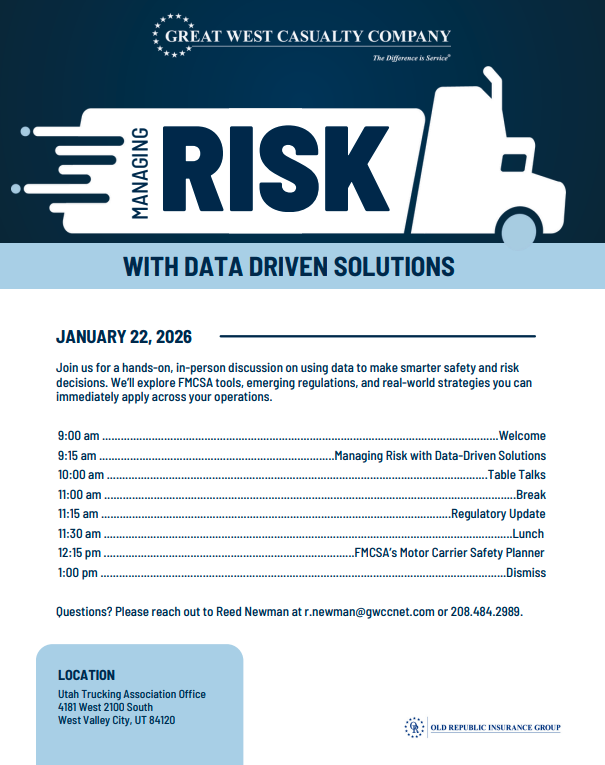
- January 22nd, 2026 – Managing Risk With Data Driven Solutions
- April 1st, 2026 – 20th Annual Southern Utah Trucking Association Charitable Golf Tournament
- May 6th – 8th, 2026 – 2026 Management Conference & Trucking Expo
Announcements
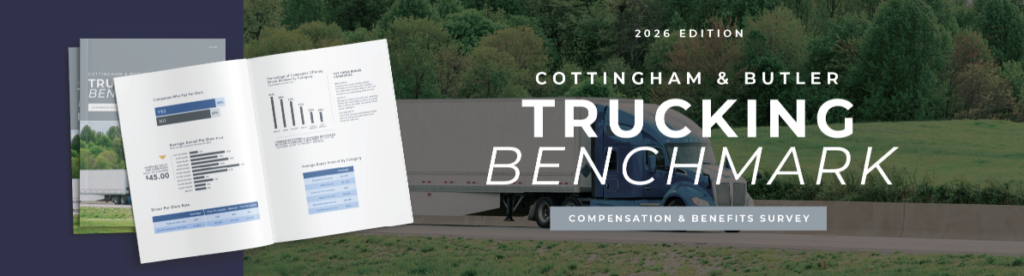
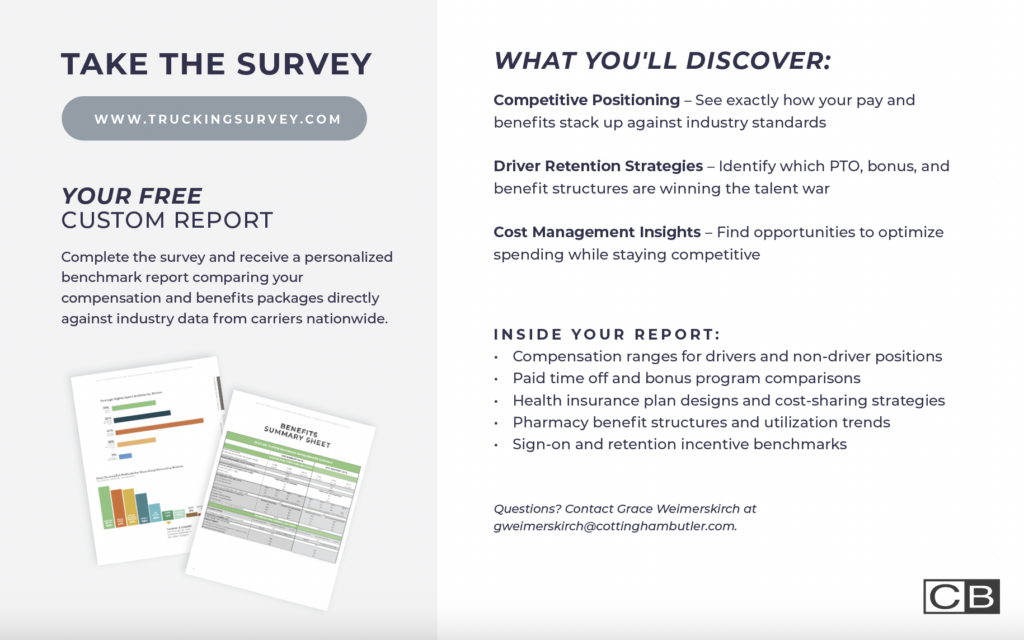
KNOW WHERE YOU STAND.
COMPETE WHERE IT COUNTS.
In today’s tight labor market, competitive compensation and benefits aren’t optional, they’re
essential. For seventeen years, Cottingham & Butler has helped motor carriers make smarter
decisions about how to attract and retain drivers without breaking the budget.
SURVEY LAUNCHES JANUARY 19 | TAKES 15-20 MINUTES | CUSTOM REPORTS DELIVERED IN JUNE!
Events:
SAVE THE DATE
(REGISTRATION OPENING SOON)

SAVE THE DATE
(REGISTRATION OPENING SOON)

Resources:
Utah Trucking Association 401K

5 Questions to Ask Before Choosing Roth Vs Pretax Retirement Savings
Jan. 13th – 1 p.m. MST
This webinar will guide you through the essential questions to consider when deciding between Roth and pretax retirement savings options. During this session, we will discuss key differences between Roth (after-tax) and pretax (traditional) contributions, and how each may impact your decisions.
How to Create an Estate Plan That Works for You
Feb 10th – 1 p.m. MST
In this informative webinar, we will cover the essential steps to building a plan tailored to your needs. Whether you’re just starting out, raising a family, or planning for retirement, this session is designed for individuals at any life stage.
Crafting a Fulfilling Retirement
Mar 10th – 1 p.m. MST
Join us this month where you’ll be guided step-by-step through the essential stages of retirement planning. From understanding Social Security and Medicare to developing smart income strategies, managing the emotional transition, and addressing estate planning, this session covers it all.


Truckin Hot News:
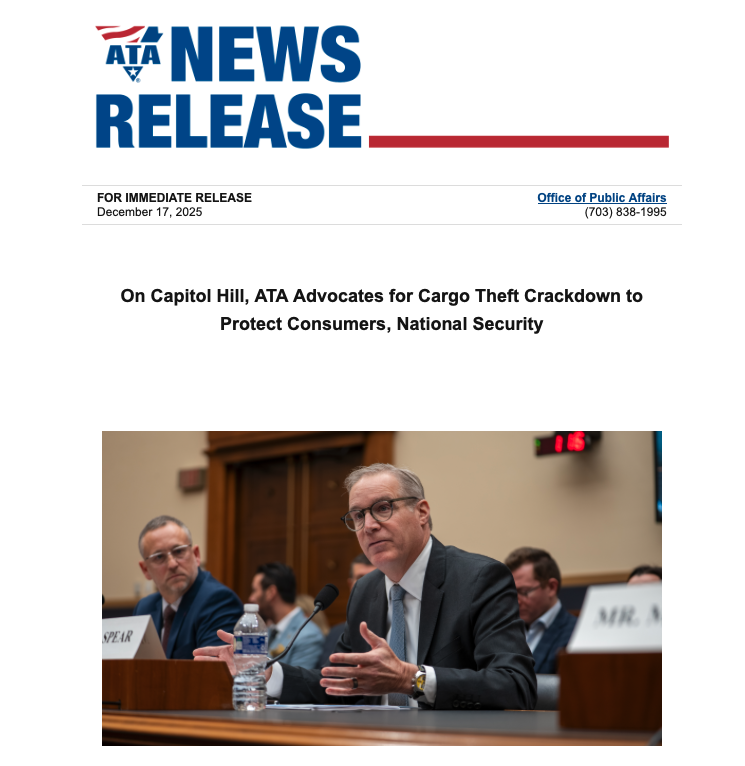
| Watch Chris Spear’s opening statement Washington – American Trucking Associations President and CEO Chris Spear testified before a House Judiciary Subcommittee today, urging Congress to take decisive action to combat the rapid rise in cargo theft that is costing the U.S. supply chain—and American consumers—billions of dollars annually as well as putting truck drivers and national security at risk. This was the ninth time ATA has been invited to speak on Capitol Hill this year. “Brazen thieves are robbing our industry to the tune of $18 million every single day,” Spear told lawmakers. “Plainly, there is a direct connection to rampant cargo theft and what Americans are paying at the grocery store. This is money that belongs in consumers’ wallets—not criminals’ pockets.” Cargo theft is becoming increasingly prevalent and high-tech, and it often originates overseas. Strategic theft, a category of crime that uses cyber fraud and identity manipulation to divert freight, has surged by 1,500% since 2021. Ninety percent of motor carriers are small businesses operating 10 trucks or fewer, and they are under enormous strain to counter their technologically advanced adversaries. The transnational aspect of cargo theft also poses a national security threat. The proceeds from stolen goods finance other criminal activities, including drug trafficking, organized crime, and even potentially terrorism. In his testimony, Spear provided an example of how appliances stolen from an ATA member were later discovered by federal agents to be part of a cartel-linked money laundering operation. Local police did not have the resources or shared intelligence to make that connection. “Trucking is interstate by nature, which means the thieves targeting the cargo we haul are interstate as well,” Spear said. “State and local law enforcement often lack the resources and the jurisdiction to adequately investigate cross-border crimes. Only the U.S. government is equipped with the capability and the constitutional authority to pursue criminals across state and international lines.” To address the crisis, Spear urged Congress to pass the Combating Organized Retail Crime Act. Introduced by a bipartisan, bicameral group of lawmakers earlier this year, CORCA would help law enforcement connect the dots by enhancing legal frameworks; improving enforcement capabilities; and fostering coordination among federal, state, and local agencies. The Department of Homeland Security would be tasked with leading a cohesive national response to cargo theft. “The theft of cargo is a nationwide problem, and it requires a national solution,” Spear said. “By bringing the fight to organized theft groups, CORCA would help safeguard Americans who work in our supply chain and protect our national security.” ATA has testified multiple times on the topic of cargo theft during the current Congress. In February, ATA member Adam Blanchard appeared before a Senate Commerce Subcommittee to relate his experience having his company’s identity stolen and becoming a victim of cargo theft. In April,ATA’s Chief Economist Bob Costello participated in a roundtable with a House Transportation & Infrastructure Subcommittee to discuss the impact that cargo theft is having on trucking operations. And in July, ATA member Donna Lemm testified before the Senate Judiciary Committee about the spike in cargo theft incidents that her company and other motor carriers are facing. +++ American Trucking Associations is the largest national trade association for the trucking industry. Through a federation of 50 affiliated state trucking associations and industry-related conferences and councils, ATA is the voice of the industry America depends on most to move our nation’s freight. Follow ATA on X or Facebook. Nothing Without Trucking. |
| Washington – Today, the American Trucking Associations applauded the passage of the National Defense Authorization Act that includes language for which ATA strongly advocated to enhance national security, support truck drivers, and add transparency and efficiency to the process of moving military families. The legislation now heads to the president’s desk to be signed into law. “In spite of the increasingly challenging political and legislative environment, ATA continues to grind out wins for the trucking industry,” said Henry Hanscom, ATA’s senior vice president of legislative affairs. “Truck drivers and motor carriers are critical to our national security, delivering military personnel and supplies where they need to be safely, securely, and on time. The significant reforms that ATA successfully secured in the annual defense bill will strengthen this essential partnership between trucking and the Pentagon.” “This bill requires military installations to provide restroom access to truck drivers delivering munitions for DoD and includes several provisions intended to address waste, fraud, and abuse in the transportation of military freight,” said Mike Matousek, director of the ATA Government Freight Conference. “Our members provide a vital service to DoD, and these reforms should improve highway safety, national security, and our partnership with a customer that our carriers are honored to serve. We appreciate Reps. Sam Graves and Derek Schmidt for their leadership on these issues, our GFC members for their continued advocacy efforts, and HASC and SASC for their consideration and support.” “The moving and storage industry is indispensable to military readiness, yet recent actions by DoD have made it increasingly difficult for our members to serve the brave men and women in our armed forces,” said Dan Hilton, executive director of the ATA Moving and Storage Conference. “Our industry takes pride in facilitating hundreds of thousands of seamless moves each year, relocating military families and their possessions wherever and whenever duty calls. We appreciate Congress’ willingness to listen to our concerns and address these issues by enacting measures that will improve the process of military moves and ensure proper oversight is in place.” Enhancing National Security Eliminate Waste, Fraud, and Abuse The bill (1) requires DoD to establish a complaint process for government and industry stakeholders to notify the Department of potential noncompliance with federal laws and agency rules regarding the transportation of military freight, (2) requires DoD to provide training to Transportation Officers and industry service providers that use the Global Freight Management system, (3) gives the Commander of Surface Deployment and Distribution Command authority to override improper or excessive actions against a transportation service provider by a military installation, and (4) requires DoD to audit the Freight Carrier Registration Program to ensure that service providers have active DOT operating authority, and that users of the system can easily identify asset-based carriers and freight brokers. Supporting Truck Drivers Mandate Restroom Access for Munitions Haulers The bill requires DoD to provide restroom access to truck drivers that haul arms, ammunition, and explosives and are required to enter a secure hold or safe haven parking location at a military installation. The restrooms are required to be well lit, address gender specific needs, and be located near the parking areas. It also requires DoD to create a process for drivers and carriers to notify the agency of potential noncompliance. Improving Relocation of Military Families Add Oversight of Certain Defense Personal Property Matters The bill contains a provision establishing the Defense Personal Property Management Office under the Office of the Under Secretary of Defense for Personnel and Readiness. The Secretary of Defense will be tasked with deciding where the DPPMO will be located within the Department of Defense and will be required to brief Congress on his plan. Set Benchmarks for Relocation Contracts The bill adds oversight requirements following the failed Global Household Goods Contract, which DoD cancelled in June 2025. GHC was a sole-source contract for the movement of service members and their families from one duty station to another that was plagued by poor planning and implementation and failed to account for the economics of the moving and storage industry meant to support the contract. The bill requires any future contracts to ensure that moving and storage companies can support military readiness and ensure the safe, reliable transportation of the possessions of military families. Study the Adequacy of Reimbursement Costs The bill requires a report to Congress on the adequacy of reimbursement for expenses incurred by servicemembers undergoing a permanent change of station. This report will provide helpful insights into these costs for military families and the armed services. Study the Permanent Change of Station Process for the Coast Guard The bill will help improve the relocation processes and services available for Coast Guard permanent changes of station by mandating a study of the current process. The report must include an evaluation of the “effectiveness of using contracted movers” for these moves, including the estimated costs associated with lost/damaged personal property; delays in scheduling these moves through a contracted mover; delayed deliveries; and other related challenges, along with recommendations to improve the Coast Guard’s permanent change of station process. |

Washington – Today, following President Trump signing an executive order that reclassifies marijuana as a Schedule III substance, American Trucking Associations’ Vice President of Safety Policy Brenna Lyles issued this statement:
“While we do not hold a formal position on marijuana legalization or deregulation, we are concerned about the safety risks of rescheduling marijuana without explicit safeguards to preserve the testing authority and technical requirements that apply to DOT-regulated, safety-sensitive workers. A safe driver is a qualified driver. And a qualified driver is drug- and alcohol-free. Motor carriers must retain reliable, enforceable tools to ensure they are not putting unqualified drivers behind the wheel.
“Without clear measures to ensure DOT’s drug- and alcohol-testing program retains—and is equipped to execute—marijuana testing authority, such a federal policy shift could have serious consequences for highway safety and the integrity of the national transportation network. This risk is exacerbated by the fact that there is currently no proven, widely accepted standard to determine marijuana impairment at roadside or before a driver begins operating a vehicle, making it far more difficult to prevent impaired driving.
“The stakes are not theoretical. Marijuana accounts for nearly 60 percent of all positive drug tests among commercial drivers subject to DOT testing requirements.
“We appreciate the Department of Transportation’s ongoing commitment to highway safety and its work to strengthen driver qualification and enforcement standards. We urge DOT to proactively coordinate with HHS, DOJ, and Congress to ensure that any federal policy shift preserves a holistic approach to safety, one that maintains the authority, tools, and technical capacity necessary to keep impaired and unqualified drivers off our roads.”
+++
American Trucking Associations is the largest national trade association for the trucking industry. Through a federation of 50 affiliated state trucking associations and industry-related conferences and councils, ATA is the voice of the industry America depends on most to move our nation’s freight. Follow ATA on X or Facebook. Nothing Without Trucking.
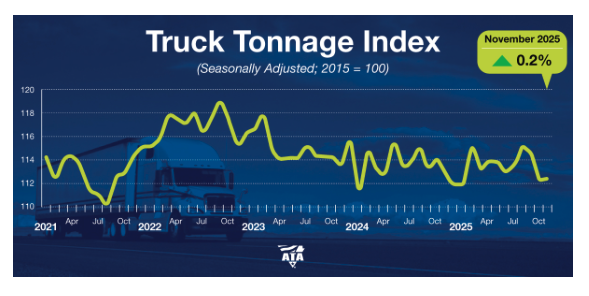
“November’s tonnage reading continues to point to a constrained freight market despite the small sequential increase,” said ATA Chief Economist Bob Costello. “The index was also down from a year earlier, the second straight year-over-year decline. In addition to challenging volumes, more capacity appears to be leaving the industry after a prolonged freight downturn and increased government enforcement measures targeting unqualified drivers and noncompliant carriers.”
In November, the ATA advanced seasonally adjusted For-Hire Truck Tonnage Index equaled 112.4, up from 112.2 in October. The index, which is based on 2015 as 100, contracted 0.3% from the same month last year after decreasing 1.5% in October. Year-to-date, compared with the same period in 2024, tonnage was unchanged.
October’s SA decrease was revised up slightly from what was first reported in our November 18 press release.
The not seasonally adjusted index, which calculates raw changes in tonnage hauled, equaled 107.3 in November, 10.2% below October’s reading of 119.5.
Trucking serves as a barometer of the U.S. economy, representing 72.7% of tonnage carried by all modes of domestic freight transportation, including manufactured and retail goods. Trucks hauled 11.27 billion tons of freight in 2024. Motor carriers collected $906 billion, or 76.9% of total revenue earned by all transport modes.
Both indices are dominated by contract freight, as opposed to traditional spot market freight. The tonnage index is calculated on surveys from its membership and has been doing so since the 1970s. This is a preliminary figure and subject to change in the final report issued around the 5th day of each month. The report includes month-to-month and year-over-year results, relevant economic comparisons, and key financial indicators.
* 2024 estimates include forecasts.
+++
American Trucking Associations is the largest national trade association for the trucking industry. Through a federation of 50 affiliated state trucking associations and industry-related conferences and councils, ATA is the voice of the industry America depends on most to move our nation’s freight. Follow ATA on X or Facebook. Nothing Without Trucking.
House Bill Would Allow Under-21 Interstate Drivers, With Limitations
A new bill introduced in the U.S. House Thursday, Dec. 11, would allow under-21 CDL holders to drive across state lines under limited circumstances. The new “Responsible Opportunity for Under-21 Trucking Engagement (ROUTE) Act” was introduced by Rep. Harriet Hageman (R-Wyoming) and referred to the House Transportation and Infrastructure Committee with no cosponsors.
White House Pushes for Marijuana Reclassification
President Donald Trump on December 18 signed an executive order to force the administration to move forward in reclassifying marijuana as a less-dangerous drug. However, that order does not legalize its use at the federal level, and what effect the move may have on commercial driver drug testing is unclear. The action would move marijuana from a Schedule 1 drug (a category that also includes heroin) to Schedule 3, a category that includes medications such as ketamine and testosterone. Schedule 3 drugs are available by prescription. Schedule I drugs are defined as substances with no currently accepted medical use and a high potential for abuse.
House Members Launch Bipartisan Congressional Trucking Caucus
First ever Congressional Trucking Caucus to focus on industry integrity, safety, growth. The Congressional Trucking Caucus will be “dedicated to issues related to the trucking industry and the policies that promote integrity, safety and the growth of our nation’s trucking economy,” the coalition said in a Dec. 12 letter registering the caucus.
Three Steps Fleets Can Take to Limit Nuclear Verdict Exposure
Fleets face rising nuclear verdict risks as maintenance gaps, driver issues, and litigation trends push safety and liability into sharper focus. Nuclear verdicts, defined as awards of $10 million or more, are increasing rapidly.
Cyber Criminals Use AI to Accelerate Cyberattacks
Bad actors have begun using AI to build out fake LinkedIn profiles, build organization charts and make connections. They’re using these profiles to get hired at companies that then send them laptops to work remotely, gaining remote access to that company’s network. That’s just one of the many ways AI can accelerate cyberattacks and expand opportunities for bad actors.
Trucking By the Numbers 2025: For-Hire vs. Private
As noted in the Trucking By the Numbers 2025 Overview, the average for-hire operating cost is about $2.26 per mile, according to the American Transportation Research Institute. But how does that compare to private costs? The National Private Truck Council’s latest annual benchmarking survey gives a general look at private fleets’ operating costs. According to NPTC’s survey of 104 companies’ costs in 2024, a private fleet’s operating cost is about $3.81 per mile.
Manufacturing Weakness and Tariff Uncertainty Cloud 2026 Outlook
The trucking industry continues to face challenging conditions, showing modest improvements in some indicators but persistent weakness in demand. FTR’s Trucking Conditions Index (TCI) rose slightly to 0.89 in October from 0.42 in September, with a mildly positive outlook for carriers through the forecast horizon.