UPCOMING EVENTS
- September 10th, 2026 – Free Driver Health Webinar for Your Carrier Members
- September 14th – 18th, 2026 – Truck Driver Appreciation Week
- September 29th, 2026 – Utah Trucking Association 2026 TruckPAC Golf Tournament
- October 7th, 2026 – Smarter Business Summit
- October 28th, 2026 – Medicare Seminar (Happy Hour) – Open House
- October 29th, 2026 – Smarter Business Summit (Doughnuts & Coffee) – Open House
Announcements
Events:


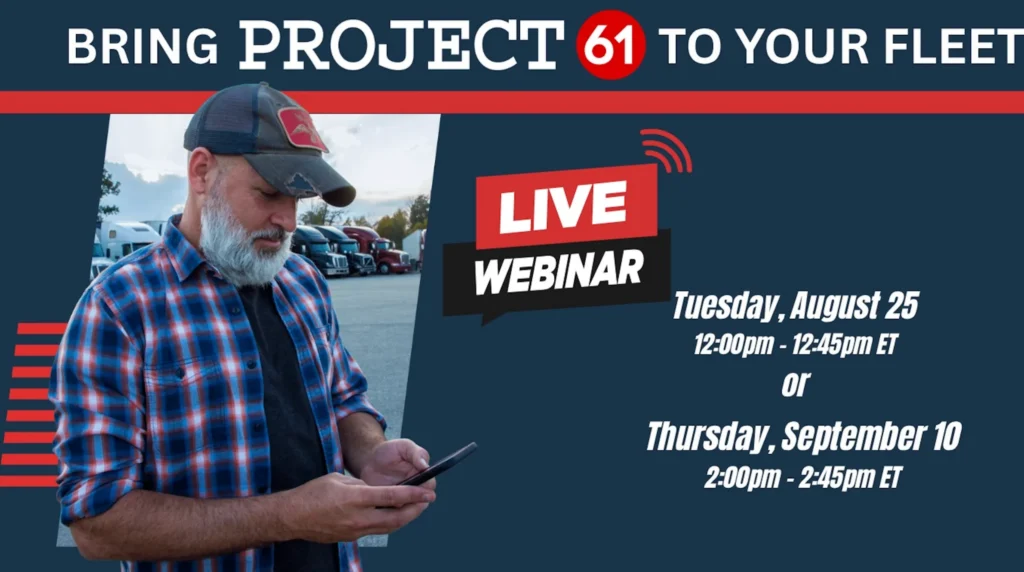
FREE WEBINAR: BRING PROJECT 61 TO YOUR FLEET
Project 61, a nonprofit focused on helping truck drivers live longer, healthier lives, is hosting a free 45-minute webinar for fleet leaders focused on practical ways to support better driver health.
Learn why driver health matters, how it connects to safety, and how your fleet can take advantage of free health resources designed specifically for professional drivers and the realities of life on the road.
Choose from two upcoming sessions:
– Thursday, September 10 at 2:00 p.m. ET
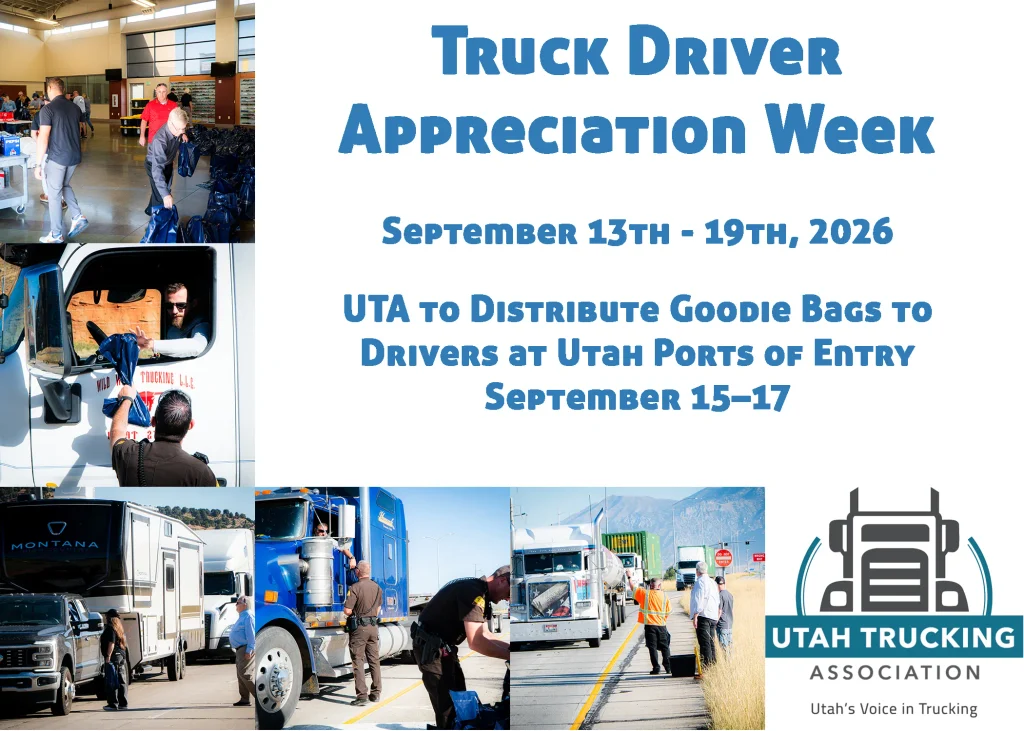
We will be passing out 250 goodies bags at each port and would like to have your participation with us at port of your choice. We are planning on stuffing the 1000 bags next Monday, September 14th at 1:00 pm at UTA Office 4181 West 2100 South in West Valley. Please bring anything you want to put in the goodie bags with you on Monday, Sept. 14th. If you can’t make the 14th bring your items with you when you visit the port. This is a great opportunity for you and your employees to show your appreciation for those drivers working and passing through our State. Don’t forget your own drivers during Driver Appreciation Week.
UTA DRIVER APPRECIATION SCHEDULE
Echo Port Tuesday, Sept. 15th 9:00 am
Perry Port Wednesday, Sept. 16th 9:00 am
Wendover Port Thursday, Sept. 17th 9:00 am
St. George Port Thursday, Sept. 17th 9:00 am



Resources:



Truckin Hot News:
Washington – American Trucking Associations Chairman Greg Hodgen issued the following statement today:
“Chris Spear informed our Executive Committee today that he will be departing the American Trucking Associations, effective immediately. On behalf of ATA, I thank Chris for more than a decade of service to the association and our industry. During his tenure, ATA secured significant policy victories, strengthened its advocacy operation, and elevated trucking’s voice in Washington.
“One of Chris’ most important accomplishments was assembling an exceptionally talented and experienced team to represent this industry. ATA has the advocacy horsepower to keep advancing our priorities without missing a beat. From our policy experts and technical professionals to our government affairs and communications teams, we have a world-class operation working together to deliver results for our members. That depth, expertise, and shared sense of purpose will continue to drive our association forward, regardless of who is at the wheel.
“ATA’s Board will convene a search committee to identify the association’s next president and CEO. As that process moves forward, our members can have full confidence in ATA’s leadership team and staff. We have a clear mission, strong momentum, and the people in place to execute. Our work continues full speed ahead, and ATA will remain a strong, unified, and effective voice for America’s trucking industry.”
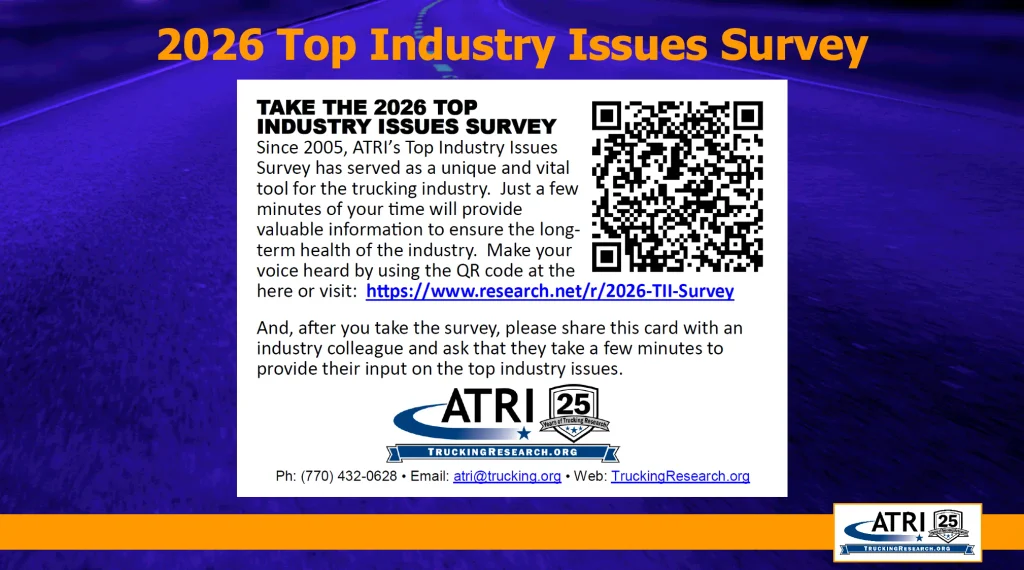
Washington, D.C. – The American Transportation Research Institute, the trucking industry’s not-for-profit research organization, today launched the 2026 Top Industry Issues Survey. The annual survey asks trucking industry stakeholders to rank the top issues of concern for the industry along with potential strategies for addressing each issue.
Now in its 22nd year, ATRI’s annual analysis not only ranks the issues overall but also provides insights into how critical topics are ranked differently by motor carriers and truck drivers. The report also allows trucking stakeholders to monitor issues over time to better understand which issues are rising, or falling, in criticality.
“For more than two decades, the Top Industry Issues list has been essential reading for any professional seeking to gain deeper insight into the current state of trucking. Compiled annually by ATRI, this report provides a crucial snapshot that identifies trucking’s biggest challenges, sets our priorities, and focuses the ATA Federation’s advocacy to develop commonsense solutions. Just as important, it serves as a valuable guide for influential policymakers who want to understand how they can best support the men and women who keep America moving,” said ATA Chair Greg Hodgen, Groendyke Transport, Inc. Chief Executive Officer.
“ATRI’s annual survey gives all truck drivers a collective voice. If your top concern is the lack of truck parking, driver compensation, detention at customer facilities, driver training, infrastructure or something else, this is your chance to bring those issues to light and have your voice heard. I encourage you to please take a few minutes to complete the online survey and encourage your peers to do so also,” said Bob Bramwell, an America’s Road Team Captain and professional truck driver for ABF Freight.
The results of the 2026 survey will be released October 18, 2026, as part of the American Trucking Associations Management Conference & Exhibition to be held in Charlotte, North Carolina.
Industry stakeholders are encouraged to complete the 2026 survey available by clicking here. The survey will remain open through October 2, 2026.
Washington—Today, the American Trucking Associations commended the House Energy & Commerce Committee for unanimously passing the Diesel Emissions Reduction Act (DERA) of 2025.
The bill was introduced by U.S. Representatives Doris Matsui (D-CA), Ken Calvert (R-CA), Chellie Pingree (D-ME), and Nick Langworthy (R-NY) and would reauthorize the DERA program through fiscal year 2029 at $100 million annually. It will now be considered by the full House of Representatives.
“For decades, the trucking industry has worked alongside policymakers to advance cleaner technologies and reduce emissions. As a result of that partnership, truck emissions of NOx and particulate matter have fallen by 99% since 1970. DERA has been instrumental in that progress, helping motor carriers invest in the newest, cleanest equipment and accelerate the deployment of proven innovations,” said ATA Chief Advocacy & Public Affairs Officer Henry Hanscom. “We applaud the committee’s unanimous vote to reauthorize this successful program and appreciate the leadership of Reps. Matsui, Calvert, Pingree, and Langworthy. Continuing DERA will strengthen supply chains, support American manufacturing jobs, and deliver further environmental benefits through a collaborative, market-based approach.”
DERA provides federal grants and rebates to help finance the voluntary replacement or retrofits of heavy-duty diesel vehicles and engines. By helping to upgrade tens of thousands of vehicles over nearly two decades, DERA is responsible for saving more than half a billion gallons of fuel.
Replacing older vehicles is critical to protecting the environment because advancements in clean diesel engine technology have resulted in substantially lower emissions. In fact, it would take 60 of today’s trucks to emit the particulates just one truck did in 1988, and over 200 trucks to emit as much NOx. A newly manufactured truck produces half the CO2 emissions of one manufactured in 2010 and produces 99% fewer NOₓ and particulate matter emissions than previous generations.
DERA is a technology-neutral program that allows for innovation and alternative fuel sources like renewable diesel, which generates a lower lifecycle carbon footprint than battery-electric vehicles at a fraction of the cost.
Dear Trucking Industry Professional:
For more than two decades, the Top Industry Issues list has been essential reading for any professional seeking to gain deeper insight into the current state of trucking. Compiled annually by the American Transportation Research Institute (ATRI), this report provides a crucial snapshot that identifies trucking’s biggest challenges, sets our priorities, and focuses the ATA Federation’s advocacy to develop commonsense solutions. Just as important, it serves as a valuable guide for influential policymakers who want to understand how they can best support the men and women who keep America moving.
In order for this publication to fulfill its important role, ATRI must hear from a broad cross-section of the trucking community. Our industry is diverse, encompassing drivers, motor carriers, suppliers, and other professionals representing businesses of every size and sector. Each of these perspectives is valuable. By gathering a wide range of viewpoints, ATRI can capture the full breadth of the issues affecting our operations.
That input is especially critical today. Trucking continues to navigate significant and complex challenges, from modernizing our nation’s infrastructure and adapting to tariffs to combating cargo theft and ending lawsuit abuse. The decisions made in Washington and state capitals will have lasting consequences for trucking, our customers, and the broader economy. We must ensure that debates over ways to strengthen our supply chain are informed by the real-world experiences of the people working on the front lines.
Completing ATRI’s 2026 Top Industry Issues survey only takes a few minutes, but its impact is far-reaching. Join me in completing the survey to ensure your voice is heard, and please encourage your employees and colleagues to do the same.
Thank you for your contributions.
Greg Hodgen
CEO, Groendyke Transport, Inc.
Chairman, American Trucking Associations
Washington—Today, the American Trucking Associations welcomed the introduction of the Stop Auto Fraud Act of 2026, bipartisan legislation to make motor vehicle collision fraud a federal crime, improve safety for drivers, and lower insurance rates nationwide.
The legislation—which was introduced by U.S. Representatives Laura Gillen (D-NY), Troy Nehls (R-TX), Josh Gottheimer (D-NJ), and Vince Fong (R-CA)—targets insurance fraud schemes in which bad actors deliberately cause, stage, or fabricate motor vehicle accidents to file false claims to obtain large cash payouts.
“On highways across the country, brazen criminals are intentionally colliding with other motorists in an attempt to score a big payday, and commercial trucks are a top target. Their selfish actions put the lives of innocent Americans at risk and contribute to soaring insurance premiums that raise costs for all consumers,” said Alex Rosen, SVP of Legislative Affairs, American Trucking Associations. “We need stronger penalties to deter those who perpetrate these schemes, which is why ATA strongly supports the Stop Auto Fraud Act. The trucking industry commends Reps. Gillen, Nehls, Gottheimer, and Fong for their leadership to make our roads safer and alleviate the financial burden imposed on families and businesses.”
“The Trucking Association of New York (TANY) thanks Congresswoman Gillen for taking a strong stand against those who put others at risk using staged accidents for their own financial gain,” said Kendra Hems, President, Trucking Association of New York (TANY). “These are serious crimes and should be treated as such. The Stop Auto Fraud Act does just that and is an important step to reign in fraud and abuse of the insurance system. For the trucking industry, fraudulent and staged claims contribute directly to unsustainable increases in commercial auto insurance costs, putting additional pressure on carriers that are working hard to operate safely and keep our economy moving. We appreciate Congresswoman Gillen’s leadership and look forward to continuing to work with her on the issue.”
Numerous schemes in recent years have targeted trucking companies, and these sophisticated fraudsters often have ties to organized crime. One such criminal ring exposed in Louisiana was the subject of a recent documentary. The saga began when a con artist deliberately crashed into a truck belonging to a third-generation, family-owned trucking business. Eventually, federal investigators unraveled a vast conspiracy involving dozens of “slammers,” “spotters,” and corrupt lawyers who orchestrated numerous operations that targeted multiple companies. In an attempted coverup, a federal witness was killed.
The Stop Auto Fraud Act would make it a federal crime to knowingly stage or fabricate a motor vehicle crash with any vehicle and submit a fraudulent claim. The bill would impose penalties, including possible jail time, for violations. Any collected fines would be paid into the Highway Trust Fund.
ATA is also backing similar legislation—the Staged Accident Fraud Prevention Act—that was introduced by Representatives Mike Collins (R-GA) and Brandon Gill (R-TX) and Senator Ashley Moody (R-FL). This bill would make it a federal crime to engineer a crash specifically with a commercial motor vehicle.

Washington—Today, American Trucking Associations Chief Advocacy & Public Affairs Officer Henry Hanscom released a statement in support of a joint operation by the U.S. Departments of Transportation and Homeland Security to permanently close 270 fraudulent CDL schools:
“ATA applauds the Trump Administration, the U.S. Department of Transportation, and the Department of Homeland Security for continuing their aggressive crackdown on fraudulent CDL training providers and other bad actors that have undermined safety and integrity within the industry. Strong enforcement measures like these send a clear message that commercial trucking is a profession that demands skill, responsibility, and adherence to the highest standards.
“Removing noncompliant carriers, unqualified drivers, and fraudulent training operations strengthens public confidence in our industry while ensuring that the next generation of professional drivers enters the workforce properly trained and fully qualified. The result is a safer highway system, a stronger supply chain, and a more level playing field for the thousands of motor carriers that follow the rules every day.
“We look forward to continuing to work with federal partners to strengthen safety, uphold industry standards, and support a trucking workforce that reflects the professionalism this essential industry demands.”
Letter to Secretary Hegseth raises concerns about unqualified providers, opaque contracting practices and risks to the defense supply chain
Washington – The American Trucking Associations today called on Secretary of War Pete Hegseth to strengthen oversight of the military freight transportation system and ensure that sensitive, taxpayer-funded shipments are entrusted only to properly vetted, qualified and compliant motor carriers.
In a letter sent today, ATA Chief Advocacy and Public Affairs Officer Henry Hanscom warned that weaknesses in the current system could jeopardize highway safety, operational security, military readiness and the integrity of the defense supply chain.
“Military readiness depends on a secure and reliable transportation network,” Hanscom said. “When military freight is awarded to providers that lack proper authority, insurance, equipment or compliance capabilities, the consequences extend far beyond contracting inefficiencies. They create risks for sensitive cargo, service members, the traveling public and taxpayers.”
ATA members have provided information to U.S. Army Transportation Command indicating that some military shipments have been awarded to service providers that lacked valid USDOT operating authority or required insurance, did not appear capable of meeting basic shipment requirements, or possessed little to no apparent asset capacity. Members also identified instances in which shipments appeared to be awarded outside normal competitive processes or manually routed around the Global Freight Management system.
A review conducted by ATA members of activity at 12 locations over a 90-day period in 2024 identified more than $20 million in shipments they believe may have been improperly awarded. Approximately 80% of the shipments reviewed at those locations appeared to have been mishandled or awarded in a manner inconsistent with longstanding Department policy.
ATA members have also raised concerns about military freight being awarded at rates substantially higher than those offered by compliant, asset-based carriers, including awards involving service providers affiliated with individuals previously convicted of federal fraud and public corruption offenses.
“At a time when American forces are deployed across active operational theaters around the world, the security and resilience of our military freight network cannot be taken for granted,” Hanscom said. “The Department has an opportunity to protect sensitive cargo, strengthen military readiness and ensure taxpayer-funded freight is awarded through fair, transparent and secure processes.”
The letter urges the Department to build on trucking enforcement efforts underway at the U.S. Department of Transportation and the U.S. Department of Homeland Security by requiring military freight providers to maintain appropriate operating authority, insurance, safety compliance and transportation capabilities.
ATA also expressed support for provisions included in the Fiscal Year 2026 National Defense Authorization Act intended to strengthen compliance, improve reporting of potential violations, clarify accountability mechanisms, audit the Freight Carrier Registration Program and require an Inspector General review.
“ATA is not simply identifying a problem. We are offering to help solve it,” Hanscom said. “Our members stand ready to work with Secretary Hegseth and his team to improve oversight, close loopholes and restore confidence in the military freight transportation system.”
A copy of the letter can be read here.
Washington—The American Trucking Associations today expressed support for the Registration Enforcement for Vehicle Operations of Known Evaders (REVOKE) Act.
The REVOKE Act was introduced by Congressmen Dave Taylor (R-OH) and Shomari Figures (D-AL), the founding Co-Chairs of the Congressional Trucking Caucus. Their legislation would strengthen U.S. Department of Transportation authority to prevent chameleon carriers from exploiting registration systems to illegally operate on American roads.
Chameleon carriers are high-risk trucking companies that are shut down and reopen under different identities—rotating through names, ownership structures, or USDOT registration numbers—to avoid penalties, enforcement actions, insurance consequences, and public scrutiny. They often continue using the same trucks, managers, drivers, and addresses while pretending to be a brand-new company.
“Chameleon carriers evade federal oversight by cycling through new registrations, putting everyone at risk. The trucking industry is committed to maintaining the highest safety standards on America’s highways, which is why we appreciate FMCSA’s ongoing efforts to identify and remove bad actors who attempt to circumvent the rules,” said ATA SVP of Legislative Affairs Alex Rosen. “The REVOKE Act would enhance FMCSA’s enforcement actions by cracking down on carriers seeking to operate under inactive USDOT numbers. ATA applauds Reps. Taylor and Figures for introducing this legislation to strengthen the integrity of our nation’s motor carrier safety framework.”
Specifically, the REVOKE Act:
- Affirms that a carrier’s USDOT number must be active in order for them to legally operate on American roadways;
- Clarifies that the Secretary of Transportation will only issue an active USDOT number to an individual or employer once determining that all requirements for registration are met; and
- Grants the Secretary of Transportation authority to immediately inactivate the USDOT number of an individual or employer if they do not have valid registration, or if they fail to make any required periodic updates to the Secretary.
Washington, D.C. – The American Transportation Research Institute (ATRI) today released new research identifying the telematics measures and functionalities that have the greatest importance to motor carriers for improving safety, operations and maintenance.
The report, From Telematics Data to Decisions: High-Value Performance Metrics for Trucking Operations, provides the industry with a focused, motor carrier-based assessment and ranking of key performance indicators (KPI) from telematics data that deliver the greatest value.
The findings determined that the metrics that have the most impact are not always the most widely used. Managing cost-per-mile, for example, received the highest Importance score in the operations category, yet was used by only 73 percent of respondents. The report’s KPI gap analysis provides fleets and telematics providers with a blueprint for focusing on KPIs that matter most.
For safety-related KPIs, the four most widely adopted metrics were critical events, speeding, risky driving behavior and hard braking.
“This research identifies the performance metrics that fleets find most valuable, and highlights those that, for some carriers, deserve more consideration,” said Robert Braswell, Executive Director of the American Trucking Associations’ (ATA) Technology & Maintenance Council (TMC). “The report gives carriers a practical guide for evaluating what they currently measure versus what they ought to measure to improve safety, maintenance and operations.”
The full report can be found on ATRI’s website here.