UPCOMING EVENTS
- April 1st, 2026 – 20th Annual Southern Utah Trucking Association Charitable Golf Tournament
- April 3rd, 2026 – BUTA Luncheon
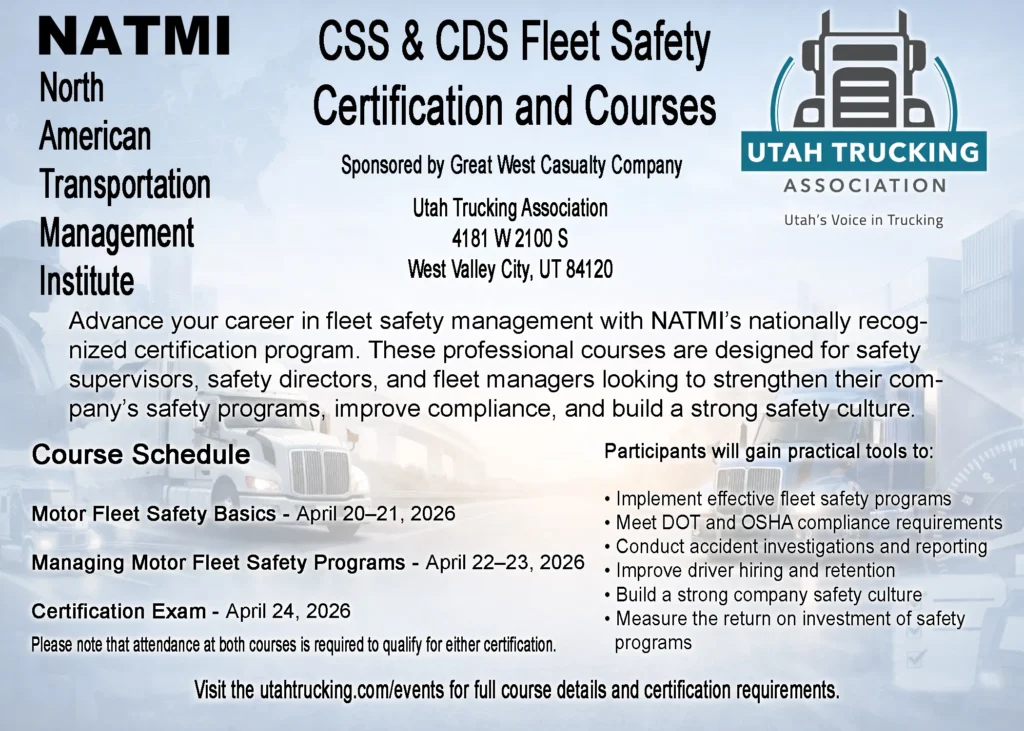
- April 20th – 24th, 2026 – NATMI CDS / CSS Fleet Safety Training
- April 24th, 2026 – Spring Warmup Sporting Clay Tournament
- May 6th – 8th, 2026 – 2026 Management Conference & Trucking Expo
- June 5th – 6th, 2026 – 2026 Utah Truck Driving Championship
- August 6th – 7th, 2026 – 2026 Rocky Mountain Regional Safety Rendezvous
Announcements
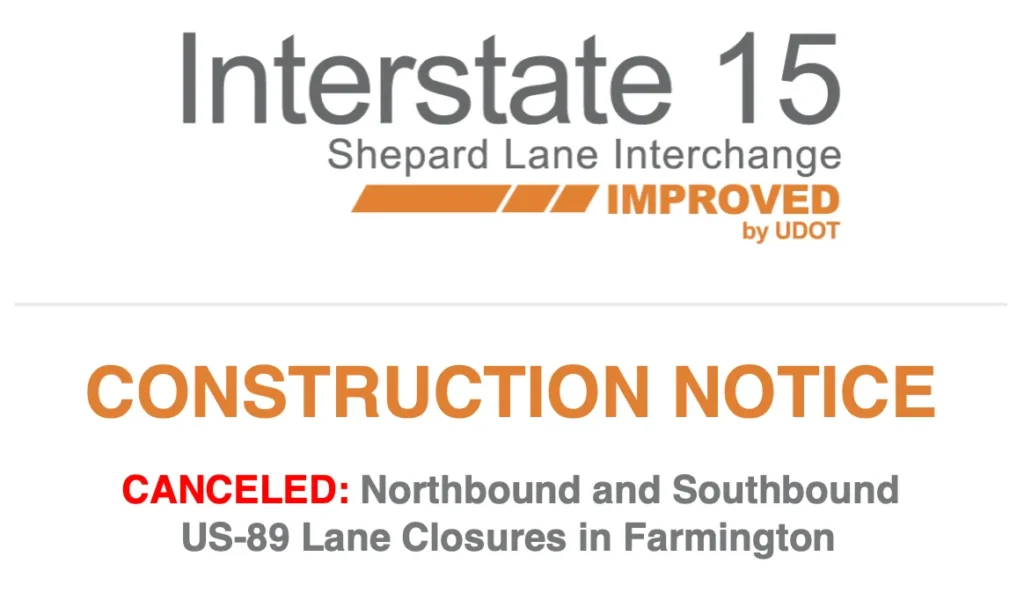
UPDATE: Lane closures on northbound and southbound US-89 between Legacy Parkway and Shepard Lane in Farmington that were scheduled for March 21 have been canceled.
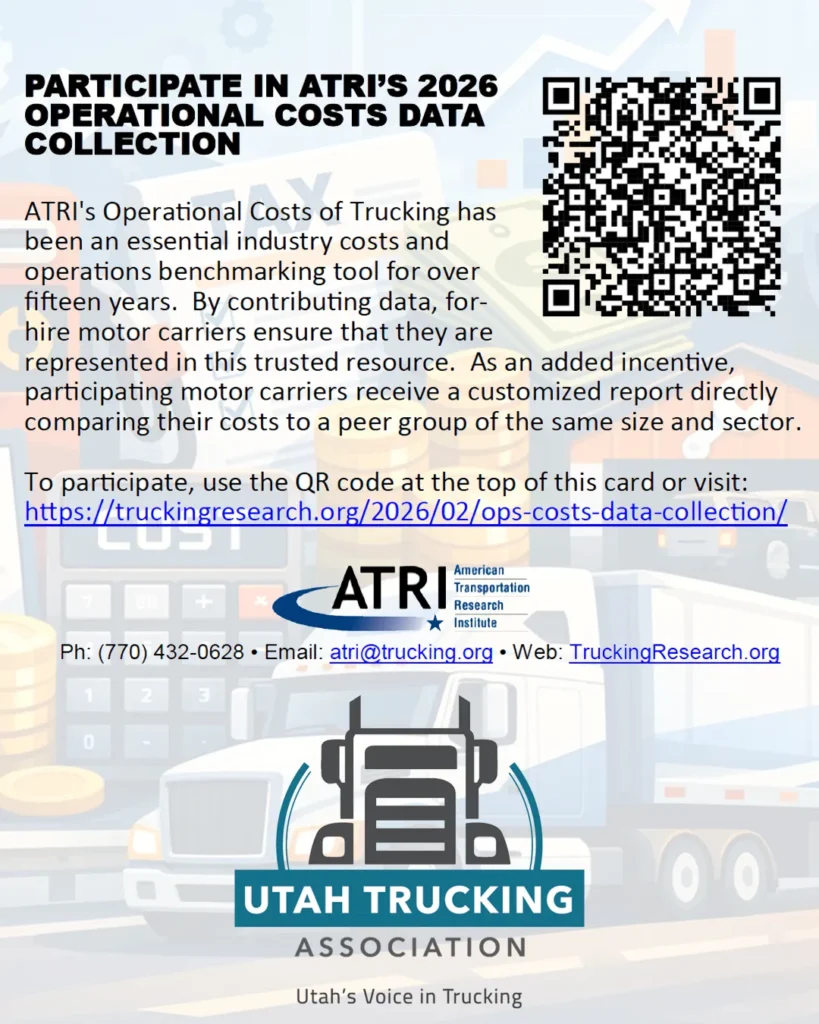

Motor Carriers: We Need Your Participation!
ATA’s 2026 Driver Compensation Survey Closes March 30
| ATA’s 2026 Driver Compensation Survey is one of the most important benchmarking tools in our industry, delivering valuable insights on driver pay, benefits, and incentives. The updated survey is faster and easier than ever to complete, and your participation is key to making the data as strong as possible. Participant benefits include:• An option to purchase the full study for just $100 (more than 90% off!)• A free executive summary ahead of the full report release• An invitation to an exclusive participant-only webinar with ATA Chief Economist, Bob Costello, to review findings and answer questions |
| Why your data matters: • Improve the accuracy of the industry’s leading driver compensation benchmarking tool• Enable detailed comparisons by carrier type, trailer type, region, and driver classification• Expand insight into pay structures, incentives, bonuses, and benefits for both employee drivers and independent contractorsTake the confidential survey today, and thank you for participating in this year’s study. |
KNOW WHERE YOU STAND.
COMPETE WHERE IT COUNTS.
In today’s tight labor market, competitive compensation and benefits aren’t optional, they’re
essential. For seventeen years, Cottingham & Butler has helped motor carriers make smarter
decisions about how to attract and retain drivers without breaking the budget.
SURVEY LAUNCHES JANUARY 19 | TAKES 15-20 MINUTES | CUSTOM REPORTS DELIVERED IN JUNE!
Events:






2026 Rocky Mountain Regional Safety Rendezvous
August 6th – 7th, 2026 Coeur d’Alene Idaho

Resources:





Truckin Hot News:
Autonomous Trucking to Put $9 Billion Back in U.S. Consumers’ Pockets Annually by 2035, $9.4 billion in annual safety benefits
By 2035, autonomous trucking projected to save shippers $5.7 billion in annual fuel costs, generate $9.4 billion in annual safety benefits, and account for up to $70 billion of U.S. GDP; Aurora commits first-of-its-kind $1 million grant to train tomorrow’s freight workforce
Washington – Today, the American Trucking Associations commended the Trump Administration for proposing an independent contractor rule that rescinds a destructive, Biden-era classification standard. ATA has long pushed for this proposed rule to protect over 350,000 independent truckers. This regulatory move would restore the first Trump Administration’s definition for independent contractors that brought clarity and order to the law in this area.
“Following years of advocacy led by ATA, the Trump Administration’s proposal represents a significant step forward to defend the livelihoods of the hundreds of thousands of truckers who choose to work as independent contractors,” said ATA President & CEO Chris Spear. “We thank President Trump for listening to the concerns of professional drivers and taking action to protect individual opportunity, our supply chain, and our economy. ATA will continue to support the effort to finalize this rule as well as urge Congress to pass legislation that would codify President Trump’s beneficial policy into law.”
The trucking industry has relied on independent contractors since the inception of interstate trucking, and court decisions over the last nine decades have continually reaffirmed the legitimate role independent contractors play in the economy.
In 2024, independent contractors came under fire when the Biden Administration radically rewrote their classification, replacing a straightforward definition with an opaque and deliberately confusing standard designed to fuel frivolous litigation and deny self-employed individuals the freedom of choice to work as independent contractors.
ATA strongly opposed the Biden Administration’s independent contractor rulesince it was first proposed and testified at a hearing on Capitol Hill to advocate for protections for independent truckers. ATA also endorsed the Modern Worker Empowerment Act, which would codify the independent contractor definition implemented under the first Trump Administration.
Many women choose to work as independent contractors because of the flexibility and entrepreneurial opportunity this employment model provides. That’s why this issue has been a priority for ATA’s Women In Motion Council, which distributed a booklet with testimonials to lawmakers on Capitol Hill during their inaugural Call on Washington. These stories served as the foundation of a powerful line of questioning at a congressional hearing involving one of the architects of the Biden-era independent contractor classification. Additionally, when ATA’s Women In Motion Council hosted their second Call on Washington last year, they reinforced their message through meetings with over three dozen congressional offices and Deputy Secretary of Labor Keith Sonderling.
Washington – Today, the American Trucking Associations applauded Senator Todd Young (R-IN) for introducing legislation to reduce freight fraud and theft, strengthen regulatory oversight, prevent unlawful operations, and enhance enforcement across the commercial motor carrier industry.
The Securing American Freight, Enforcement, and Reliability in Transport (SAFER Transport) Act represents a direct response to issues that were raised during a Senate Commerce Subcommittee hearing that Senator Young chaired last year on rising incidents of cargo theft. Testifying on behalf of ATA, an owner of a trucking small business described how his company’s identity was stolen by technologically advanced criminals, who used that information to divert and steal loads. The con artists took advantage of weaknesses in FMCSA’s Safety and Fitness Electronic Records (SAFER) System to perpetrate their crime.
“Over 90% of trucking fleets operate 10 trucks or fewer, and each one embodies the American Dream. Motor carriers spend years building their reputations, but ruthless and sophisticated criminals are actively exploiting loopholes in USDOT’s registration process to steal their identities, capitalize on their good names, and commit cargo theft,” said American Trucking Associations President & CEO Chris Spear. “Small businesses are not equipped to fight large-scale fraud on their own, which is why it is so critical to implement Senator Young’s commonsense reforms that modernize USDOT’s systems to weed out chameleon carriers and enhance oversight and penalties. We are grateful for his willingness to listen to the voices of hardworking truckers.”
“Indiana’s predominantly family-owned trucking companies are locked in a rapidly escalating arms race against high-tech thieves,” said Gary Langston, president of the Indiana Motor Truck Association. “Identity theft and cargo heists have become an epidemic, and the outdated USDOT system has left the back door wide open for criminals to target motor carriers. We thank Senator Young for introducing this legislation that will help eliminate vulnerabilities related to registration, CDL issuance, and training and finally give our industry the backup it needs to fight fraud. These reforms will protect Indiana trucking fleets and the hundreds of thousands of Hoosiers they employ.”
ATA has long warned that insufficient oversight has undermined safety and allowed bad actors to proliferate. In addition to calling for a crackdown on fraud, the Federation has advocated for regulations and legislation to improve CDL integrity, strengthen driver qualifications, shut down CDL mills, and put a stop to cabotage.
As a comprehensive freight security and registration integrity reform bill, the SAFER Transport Act aligns with ATA’s recommendations by:
- Modernizing and securing FMCSA’s registration system;
- Phasing out outdated MC numbers in favor of USDOT numbers;
- Strengthening fraud detection and enforcement tools;
- Enhancing oversight of CDL issuance and training providers;
- Increasing criminal penalties for fraudulent certifications;
- Improving interagency coordination on freight theft and cabotage enforcement; and
- Closing regulatory loopholes involving foreign dispatch services.
Cargo theft is becoming increasingly prevalent and high-tech, and it often originates overseas. The American Transportation Research Institute calculated that cargo theft is costing the trucking industry over $18 million per day. Strategic theft, a category of crime that uses cyber fraud and identity manipulation to divert freight, has surged by 1,500% since 2021 according to CargoNet.
In February 2025, Adam Blanchard, the co-founder and CEO of Double Diamond Transport and Tanager Logistics, represented ATA before the Subcommittee on Surface Transportation, Freight, Pipelines, and Safety at the invitation of the chairman, Senator Young. Blanchard explained how sophisticated criminals created a fake Tanager Logistics—even adding their bogus company to FMCSA’s SAFER website—and brokered loads to unsuspecting carriers. One shipment of energy drinks worth over six figures was rerouted over 1,000 miles from its intended destination.
Blanchard’s company—the real Tanager Logistics—played whack-a-mole and suffered reputational damage while the scammers pocketed the money. When Blanchard repeatedly contacted the authorities, however, the response he received was indifference. Even when he informed FMCSA about the counterfeit Tanager Logistics on its website, the agency refused to remove the imposter.
The SAFER Transport Act would protect trucking companies by enhancing the integrity of FMCSA’s registration system and taking additional steps to root out fraud.
Click here to watch
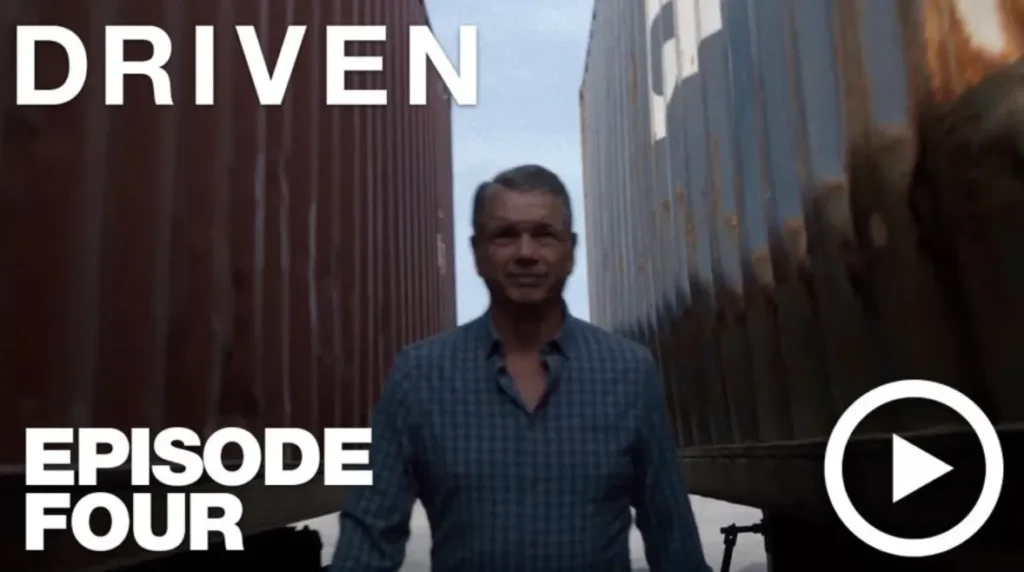
Washington – Today, Nothing Without Trucking, in association with ACT 1, released the latest episode of the documentary series DRIVEN that shines a spotlight on trucking professionals who keep our nation rolling through good times and bad.
The latest episode titled “Jackpot Justice” exposes an epidemic of staged accidents targeting reputable motor carriers and endangering innocent truck drivers. This infamous phenomenon manipulates the legal system to extort trucking companies for settlements, and the costs are borne by everyone in the form of elevated insurance premiums, lost jobs, and higher prices for goods.
The documentary highlights the experience of a third-generation, family owned trucking business in Louisiana, an ordeal that began when a con artist deliberately crashed into one of their trucks to score a big insurance payout. Eventually, federal investigators unraveled a vast conspiracy involving dozens of “slammers,” “spotters,” and corrupt lawyers who orchestrated numerous operations that targeted multiple companies. In an attempted coverup, a federal witness was killed. The short film follows the victims’ quest to ensure the kingpins of staged accidents are put behind bars.
“Con artists who intentionally collide with commercial motor vehicles put truck drivers and the motoring public at risk through their reckless disregard for safety. When these unscrupulous and selfish individuals file frivolous lawsuits against honest trucking companies to score a big payout, they inflate costs for everyone,” said American Trucking Associations President & CEO Chris Spear. “This documentary sheds light on how shameless profiteering has perverted the civil justice at the expense of everyone else. By raising awareness among the public and policymakers, we can restore fairness and integrity to our justice system and hold wrongdoers accountable.”
“This story is not about me,” said Randy Guillot, president of Triple G Express, featured in the documentary. “It’s about everyone, because everyone in this country pays for fraud. I urge Louisiana’s elected officials at the state and federal level to enact common sense reforms that can restore truth and transparency to the justice system.”
The American Trucking Associations has made it a top priority to reign in lawsuit abuse and put an end to damaging practices like staged accidents. As part of this campaign, ATA launched a new digital resource last month, StopLawsuitAbuse.info, to educate policymakers, the media, and the public about this growing problem for America’s trucking industry, small businesses, and professional drivers.
The website features:
- Video testimonials from truckers and small business owners sharing firsthand experiences;
- Data and statistics that illustrate the economic and operational impacts of lawsuit abuse in all 50 states; and
- Legislative solutions that policymakers can pursue to level the playing field.
To learn more and explore the new resource, visit StopLawsuitAbuse.info.
Washington – Today, the American Trucking Associations’ Women In Motion Council called on two congressional committees to prioritize expanding access to truck parking in the upcoming surface transportation reauthorization.
WIM Chair Emily Williams sent the letters to the leaders of the U.S. House Committee on Transportation & Infrastructure and the U.S. Senate Committee on Environment & Public Works in response to feedback from WIM members that a lack of truck parking is severely limiting opportunities for women to pursue trucking careers. The two committees are tasked with updating and extending the nation’s highway programs before they expire on September 30th.
“Amenities like lighted parking lots, bathroom access, and on-site security are not simply matters of convenience—they are essential to ensuring women’s safety and wellbeing,” Williams wrote. “Serious safety implications exist for the broader public as well. When trucks are forced to park in unmarked and unauthorized locations, such as along highway ramps, it creates hazards for truck drivers and motorists alike, contributing to thousands of crashes each year.”
“[Investing in truck parking] would address a basic safety and workforce necessity for our nation’s 3.6 million truck drivers, including hundreds of thousands of women truck drivers, who deserve a safe, secure place to rest at the end of their shifts,” Williams continued. “This is the least we can do for America’s essential workforce.”
According to a USDOT study, 98% of truck drivers regularly experience problems locating safe parking. An analysis by the American Transportation Research Institute found that the average driver sacrifices 56 minutes of drive time per day. This results in $6,813 in lost wages for truck drivers each year.
Increasing investments in truck parking is a bipartisan issue. The last surface transportation reauthorization in 2021 supported the construction of roughly 2,000 truck parking spaces. Additionally, the fiscal year 2026 transportation funding bill that was signed into law earlier this year allocated significant new funding specifically to expand truck parking.
“We urge [Congress] to build on this momentum by paving the way for meaningful, sustained investments in truck parking in the next surface transportation bill,” Williams concluded.
Washington – Today, the American Trucking Associations applauded the Trump Administration for proposing a rule that would strengthen CDL training schools and diesel mechanic training programs.
When finalized, the rule will establish a new “Workforce Pell Grant” pathway to allow eligible students to use Pell Grants for educational courses lasting from 8 to 15 weeks. Currently, Pell Grants can only be applied to programs with a duration of 15 or more weeks, rendering students in shorter-term, high-quality job training ineligible for this crucial assistance. This reform implements provisions in the Big, Beautiful Bill for which ATA advocated to help students enroll in credentialing programs that meet federal and state quality standards. The change would dismantle financial barriers that prevent students from low-income households from accessing the career pathways that lead to the trucking industry.
“Supporting professional, qualified drivers is essential to ensuring our industry can continue to deliver the nation’s freight safely and efficiently,” said American Trucking Associations Chief Advocacy & Public Affairs Officer Henry Hanscom. “By expanding Pell Grant flexibility to make short-term educational programs eligible, this rulemaking will open the door of opportunity to more young people seeking rewarding, good-paying careers in trucking. ATA commends Congress and the Trump Administration for supporting this profession that provides a middle-class lifestyle to Americans without the time and expense of a four-year college degree.”
The proposed rule was published in the Federal Register and is now open for a public comment period before being finalized.
Washington – A new report from American Trucking Associations’ Technology & Maintenance Council and Decisiv Inc. indicated parts and labor costs fell in the fourth quarter of 2025.
After rising in Q3 2025, combined parts and labor costs in the Decisiv/TMC Parts & Labor Service Benchmark Report decreased by 1.3 percent. The drop in Quarter-over-Quarter (QoQ) combined expenses included -0.4 percent lower parts costs and a -2.6 percent reduction in labor costs. This across-the-board moderation followed sizable cost increases in Q3 2025 seen in 3.8 percent higher combined expenses during the previous quarter.
Year-over-Year (YoY) in Q4 2025, combined parts and labor costs increased 2.0 percent, continuing a year-long upward trend. However, this contrasts with the previous quarter when both parts and labor costs rose YoY. In the current quarter parts costs jumped by 3.7 percent while labor costs fell by -0.4 percent.
The drop in quarterly costs reflects lower freight volumes and mileage. For Q4 2025, the American Trucking Associations advanced seasonally adjusted For-Hire Truck Tonnage Index average fell 1.8 percent from the third quarter and was down 0.3 percent compared to the final three months in 2024. These low levels of trucking volumes, according to ATA, were suppressed by soft manufacturing and construction activity. For 2025 in total, tonnage rose just 0.1 percent over the 2024 average.
In Q4 2025, combined parts and labor cost increases were recorded in 10 of the 25 VMRS Systems tracked in the Decisiv TMC Benchmark Report, seven fewer than in the previous quarter. QoQ parts cost rose in 10 systems, also seven less than in Q3, and labor costs were up in just seven systems, down considerably from 15 systems in the previous quarterly analysis.
YoY combined parts and labor costs were higher in 16 VMRS Systems, one more than in the previous quarter. Parts costs were up in 19 systems, four more than in the previous YoY analysis, while 11 systems with higher YoY labors represented four fewer than in Q3 2025.
“Across the industry, fleets are called upon to manage fluctuating costs with consistent service approaches,” said Tim Hardin, President and CEO of Decisiv. “The moderation in costs seen in the current Decisiv/TMC Parts & Labor Service Benchmark Report illustrates how this is being addressed at shops using effective management practices.”
To provide a highly accurate understanding of service costs, the Decisiv TMC Benchmark Report is now based on a more extensive dataset. The result of greater encoding precision that adds cost information across all VMRS codes included in the quarterly data, the report now presents an improved view of service costs for deeper activity and trend analyses.
The Decisiv/TMC Parts & Labor Service Benchmark is based on comprehensive service data. For the report, Decisiv collects and analyzes parts and labor costs for 25 VMRS system-level codes. These codes account for more than 97 percent of total parts and labor spending on more than seven million assets during 300,000+ monthly maintenance and repair events at 5,000+ service locations.
“This quarter’s data on various parts and labor categories is welcome news for fleets,” said TMC Executive Director Robert Braswell. “The information delivered in the Decisiv/TMC Parts & Labor Service Benchmark continues to provide Council members an excellent means of comparing how their operations are performing to industry trends so they can take action accordingly to changing industry conditions.”
TMC issues the reports to its fleet members. The reports are organized based on the Council’s VMRS, sorted by VMRS-coded vehicle systems and geographic location.
TMC fleet members will receive the report electronically via email. For more information on joining TMC, call (703) 838-1763 or visit http://tmc.trucking.org.
Washington – The American Trucking Associations applauded the Trump Administration and members of the House Transportation & Infrastructure Committee for unveiling legislation today that would strengthen the integrity of the CDL system.
In advance of the committee mark-up scheduled for Wednesday, March 18, ATA President & CEO Chris Spear released this statement:
We thank President Trump, Secretary Duffy, Administrator Barrs, and the House Transportation & Infrastructure Committee for their leadership and commitment to enforcing the laws that keep our highways safe.
Strengthening the integrity of the commercial driver’s license system is essential to restoring accountability, removing bad actors from the road, and protecting the overwhelming majority of professional truck drivers who follow the rules and uphold high standards.
The motoring public deserves confidence in who is operating heavy commercial vehicles. This legislation reinforces that trust by ensuring drivers are properly trained, tested, and qualified. By holding states accountable for how CDLs are issued, the bill establishes a consistent, lawful framework for employment in this safety‑critical industry—setting uniform testing standards and improving employer notification systems so agencies and industry can better share information. Together, these reforms increase transparency, support responsible carriers and drivers, and strengthen the safety and reliability of the nation’s freight network.
ATA will remain engaged throughout the legislative process to ensure the final product delivers real accountability, consistent enforcement, and the high safety standards that benefit everyone on the road.
Nashville – Today, American Trucking Associations’ Technology & Maintenance Council announced Mark Kennedy, corporate vice president of equipment, Knight Swift Transportation, Inc., has been installed as 2026-2027 general chairman and treasurer during the organization’s Annual Meeting & Transportation Technology Exhibition.
“Mark has been an exemplary member of TMC, including winning the Council’s highest honor — the Silver Spark Plug,” said TMC Executive Director Robert Braswell. “His professionalism and commitment to trucking make him an outstanding choice to be TMC general chairman and treasurer.”
Kennedy, based in Phoenix, Arizona, served the past year as the Council’s vice chairman and chairman of meetings. He succeeds Radu Mihai, corporate fleet manager, BURNCO Rock Products, as general chairman and treasurer.
“I’m honored to accept this position from my fellow TMC members,” Kennedy said. “I look forward to working with the rest of TMC’s leadership to advance our industry’s goals. I also want to thank Radu for his service to our organization.”
“Serving as general chairman and treasurer has been an incredible honor for me, and I want to thank my fellow TMC members for this opportunity,” Mihai said. “As I hand off the chairmanship of TMC, I want to congratulate Mark on his election and wish him great success. I’m sure he will be an outstanding leader for our Council.”
Others serving as TMC officers for 2026-2027 include:
- Vice Chairman and Chairman of Meetings: Joey Young, Publix Super Markets, Inc.
- Chairman of Study Groups: Anthony Marshall, UPS
- Chairman of Membership and Publicity: Larry Rambeaux, Purkeys
- Chairman of Associates: Roger Maye, ConMet
- Immediate Past Chairman Mihai
- Executive Director Braswell
Directors-at-large include:
Ken Marko, US Foods
Brian Liimatta, Cummins
Scott Bartlein, Truck Fleet Management
Kurt Dunn, PITT OHIO
Brent Hilton, Maverick Transportation
Randy Obermeyer, Online Transport, Inc.
Kevin Tomlinson, Shrader Tire & Oil Company

Washington – Today, the American Trucking Associations, Truckload Carriers Association, National Tank Truck Carriers, and state trucking associations across the country issued the following joint statement in support of Dalilah’s Law, which will be considered by the House Transportation & Infrastructure Committee tomorrow, March 18th:
America’s trucking industry strongly supports Dalilah’s Law and the effort to strengthen the integrity of the commercial driver’s license system. We appreciate the leadership of Secretary Duffy, Administrator Barrs, and the House Transportation and Infrastructure Committee in answering the President’s call during the State of the Union Address to strengthen roadway safety.
Ensuring that commercial drivers are properly trained, tested, and qualified is essential to protecting the motoring public and the professional truck drivers who safely move America’s freight every day. By reinforcing accountability and consistent enforcement in the CDL system, this legislation helps remove bad actors from the road while supporting the overwhelming majority of drivers and carriers who operate safely and by the book.
We look forward to working with Congress and the Administration as Dalilah’s Law advances through the legislative process.
Washington – Today, members of the American Trucking Associations’ Law Enforcement Advisory Board wrote to leaders of the House as well as the chairman and ranking member of the Senate Judiciary Committee to urge them to swiftly pass legislation to address skyrocketing cases of cargo theft.
LEAB is composed of current or former public safety officials who are dedicated to strengthening the relationship between trucking and law enforcement to boost the safety and security of U.S. roadways. The group strongly supports the Combating Organized Retail Crime Act because it would help law enforcement connect the dots and solve crimes that target the supply chain.
“Cargo theft is not merely a property crime—it is a growing public safety threat that endangers drivers, law enforcement personnel, and the traveling public,” the leaders of LEAB wrote. “Those of us charged with protecting commercial motor vehicle operations see firsthand how organized theft groups target freight corridors, distribution hubs, and drivers. Federal coordination is indispensable to confronting this threat and ensuring the safety of our transportation system.”
The Combating Organized Retail Crime Actpassed the House Judiciary Committee unanimously in January and is cosponsored by approximately half of both the House and Senate. The bill would strengthen law enforcement’s capabilities to dismantle organized theft groups by enhancing legal frameworks; improving enforcement capabilities; and fostering coordination among federal, state, and local agencies.
“Swift passage of this critical legislation will provide law enforcement with the federal partnership we urgently need to protect drivers, safeguard freight corridors, and secure the nation’s supply chains,” the leaders of LEAB concluded.
Cargo theft is becoming increasingly prevalent and high-tech, and it often originates overseas. The American Transportation Research Institute calculated that cargo theft is costing the trucking industry over $18 million per day. Strategic theft, a category of crime that uses cyber fraud and identity manipulation to divert freight, has surged by 1,500% since 2021 according to CargoNet. Ninety percent of motor carriers are small businesses operating 10 trucks or fewer, and they are under enormous strain to counter their technologically advanced adversaries. The transnational aspect of cargo theft also poses a national security threat. The proceeds from stolen goods finance other criminal activities, including drug trafficking, organized crime, and even potentially terrorism.
ATA is a leading champion of the Combating Organized Retail Crime Act and has served as a key witness at multiple congressional hearings. Most recently, ATA President & CEO Chris Spear testified before a House Judiciary Subcommittee in December to urge lawmakers to support the bill.
Washington – Today, the American Trucking Associations thanked members of the House Transportation & Infrastructure Committee for advancing Dalilah’s Law, which would strengthen CDL requirements as well as ensure truck drivers are properly trained and meet safety standards.
ATA endorsed the bill when it was introduced by Congressman David Rouzer (R-NC) on Monday. The Truckload Carriers Association, National Tank Truck Carriers, and state trucking assocaitions across the country joined ATA in support.
Following today’s successful committee vote, ATA President & CEO Chris Spear issued this statement:
“For those hauling freight on America’s highways, safety is not optional—it is the price of admission. The trucking industry is grateful to members of the House T&I Committee for reaffirming this principle by passing Dalilah’s Law. This legislation would protect the overwhelming majority of motor carriers and truck drivers who are committed to upholding the highest standards.
“Rules are only effective when they are consistently enforced. Bad actors who cheat the system and cut corners undermine responsible fleets and create unacceptable hazards for everyone.
“Dalilah’s Law would restore accountability by establishing rigorous, consistent requirements for CDL testing, issuance, and oversight. This is an example of government and industry partnering together to fix a real problem. We applaud President Trump, Secretary Duffy, and Congressman Rouzer for answering the call to strengthen safety, and we look forward to continuing to work with them to get this bill across the finish line.”
Among other provisions, Dalilah’s Law would improve roadway safety by:
- Ensuring consistent enforcement of English language proficiency requirements during roadside inspections and making clear that drivers who cannot meet those standards should be placed out of service;
- Modernizing the driver record notification system so motor carriers are promptly alerted if a driver’s CDL has been revoked, suspended, or is otherwise invalid; and
- Requiring the U.S. Department of Transportation to strengthen oversight of training providers, ensuring new drivers receive the instruction they need to operate safely.